Last updated: October 2026
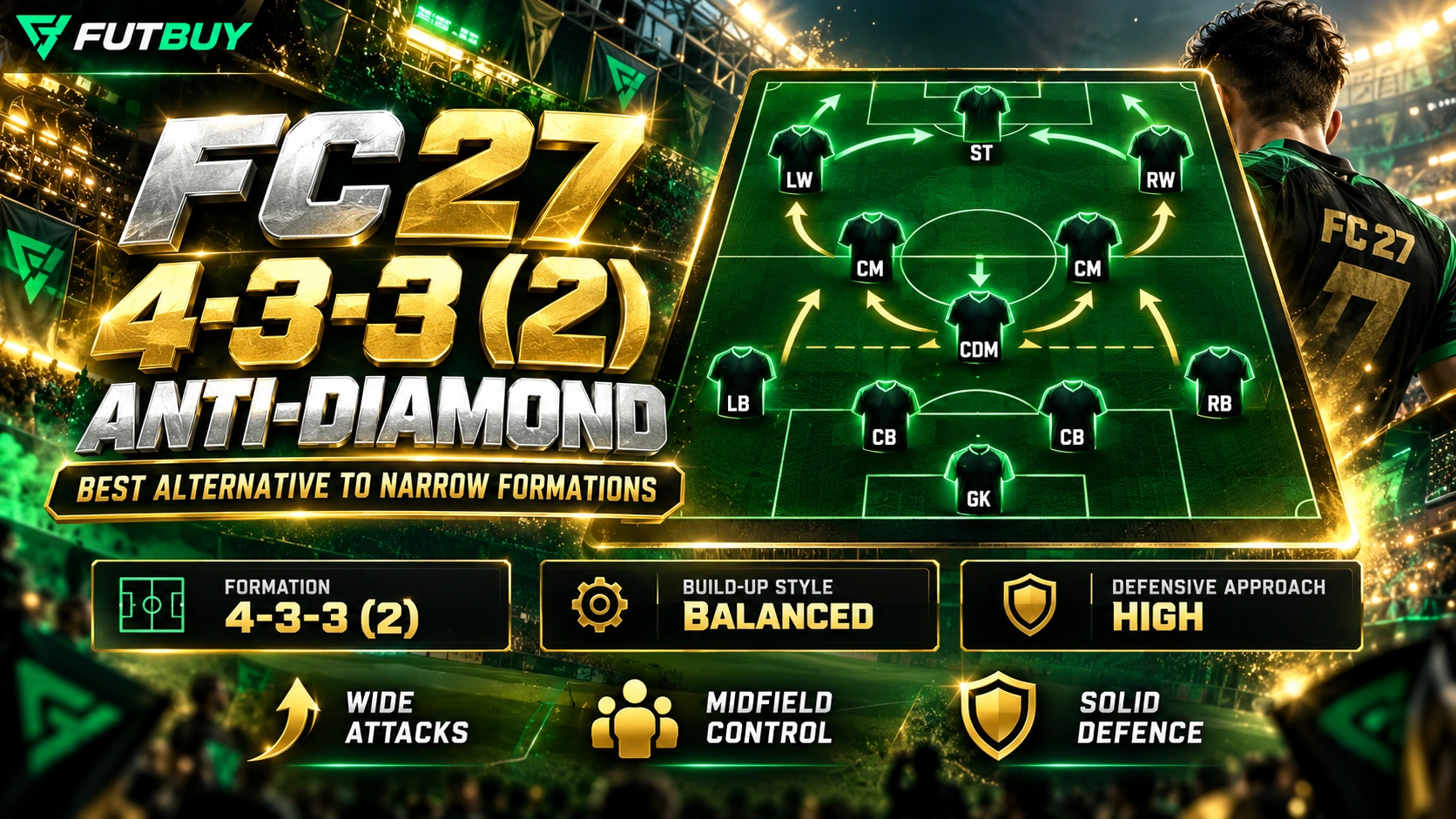
Quick Answer
Tired of facing the same narrow formations in FC 27? The 4-3-3 (2) could be exactly what you need.
With formations like 4-3-1-2 and 4-1-2-1-2 (2) dominating much of the current Ultimate Team meta, many players are looking for an effective alternative.
We recently tested a 4-3-3 (2) setup inspired by professional players RvPLegend10, the 2026 FC Pro World Champion, and Jonny, the 2024 eChampions League winner.
And the results were surprisingly good.
The biggest advantage of this formation is its ability to combine attacking width with a compact three-man midfield.
Your wingers create opportunities on the counterattack, your central midfielders support possession and your CDM provides additional defensive protection.
Unlike the narrow formations that rely heavily on central combinations, the 4-3-3 (2) gives you different ways to attack without sacrificing too much defensive structure.
Our early verdict: This is one of the most interesting formations to try if you're tired of the narrow FC 27 meta.
FC 27 4-3-3 (2) Anti-Diamond Custom Tactics
Let's start with the exact configuration.

FC 27 Anti-Diamond Tactics Code
ABZgi2c#K?2B
Import the code through the Custom Tactics menu to reproduce the shared setup.
The most important thing to understand is that this is not simply a traditional 4-3-3 where everyone stays wide.
The combination of Inside Forwards, a False 9 and two active central midfielders gives the formation a much more interesting structure.
It can attack quickly through the wings, but it also has enough central support to play more patiently.
Why Is 4-3-3 (2) Called the Anti-Diamond?
The answer is simple: it attacks the spaces that narrow formations often struggle to cover while still maintaining numbers in central midfield.
Take the popular 4-1-2-1-2 (2).
This formation is extremely compact and gives the opponent plenty of central passing options.
The same can be said about 4-3-1-2.
Both formations can be dangerous when their players combine quickly through the middle.
However, their narrow attacking shapes create an opportunity for teams with natural width.
In the 4-3-3 (2), your LW and RW can stretch the opposition horizontally, forcing the opponent to defend larger areas of the pitch.
This becomes particularly important during counterattacks.
Instead of trying to force another pass into a crowded central area, you can move the ball toward your winger and attack the space outside the opponent's midfield.
At the same time, your three central midfielders help prevent the opposition from completely controlling the middle.
That is the reason we call this setup Anti-Diamond.
It offers a natural answer to the narrow attacking patterns that have become so common in FC 27.
How to Attack With 4-3-3 (2)
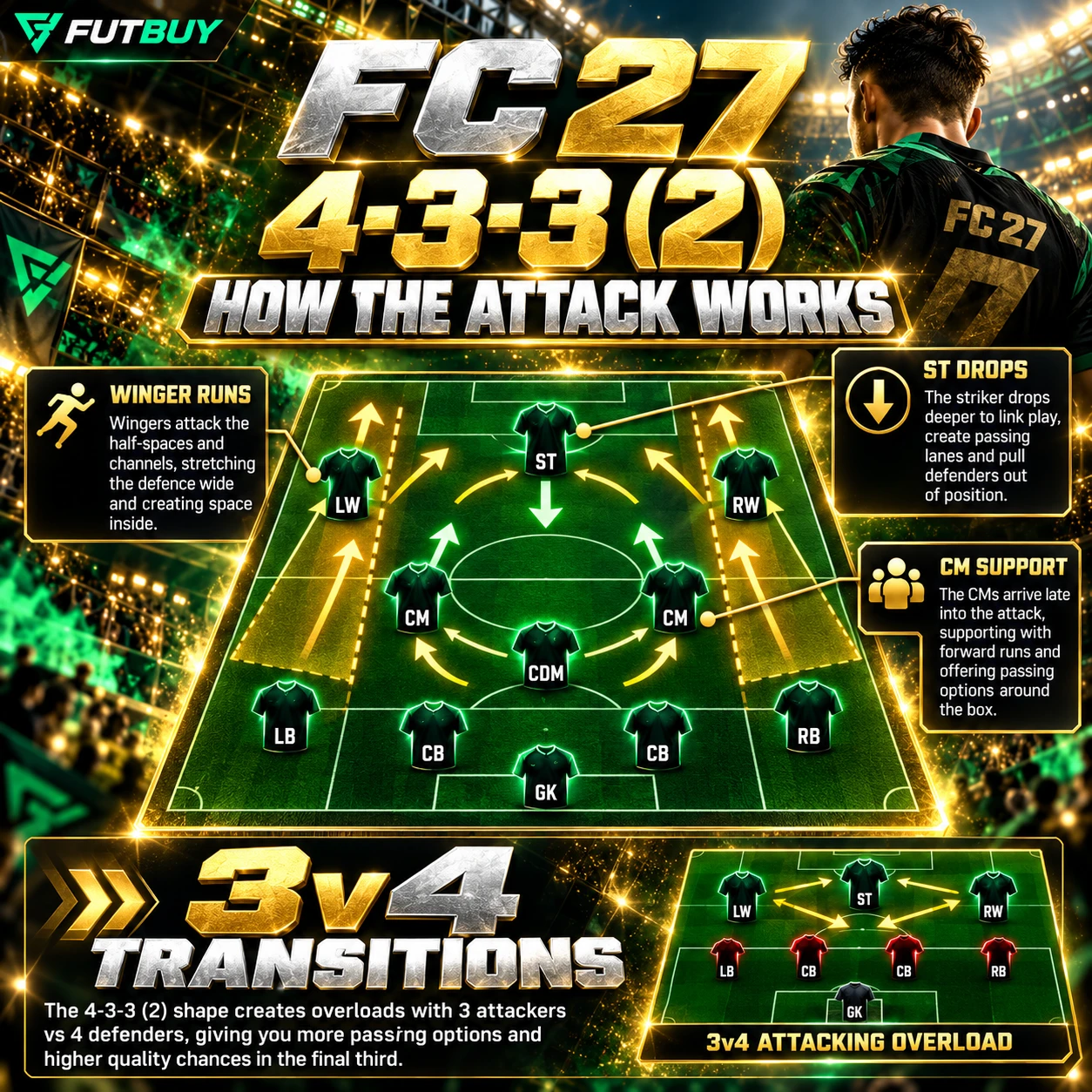
1. Use Your Wingers to Create Fast Counterattacks
The first major advantage is how easy it can be to move forward through your LW and RW.
With two attacking players positioned across the width of the pitch, you have immediate options when recovering possession.
Imagine a typical situation.
Your CDM wins the ball, and the opponent has already committed several midfielders forward.
Instead of trying to pass directly through the middle, you can find one of your wingers.
Suddenly, you have the opportunity to create a dangerous counterattack.
This is particularly useful in 3v4 attacking situations.
Even when the opponent has four defenders covering your three forwards, the attack can still be dangerous because your wingers provide width and space.
However, there is one important detail.
Do not rush every attack.
A 3v4 counterattack does not mean you need to force a shot immediately.
Sometimes holding possession for an extra second is the difference between losing the ball and creating a clear chance.
2. Let Your Central Midfielders Join the Attack
This is probably our favourite feature of the formation.
If you avoid rushing forward immediately, your two central midfielders often have time to support the attacking move.
This creates additional passing options around the edge of the penalty area.
Instead of attacking with only three players, you can gradually involve one or both CMs.
For example:
Your LW receives the ball on the left.
The striker moves into a supporting position.
Your LCM begins moving forward.
You play a short pass inside.
The midfielder can now combine with the striker or release a winger behind the defence.
The attacking structure becomes much more flexible.
This is particularly useful against opponents who defend aggressively and try to intercept the first forward pass.
The key is patience. Allow your midfielders to arrive instead of forcing every counterattack.
3. Use the False 9 to Create Central Passing Options
One of the most interesting parts of the provided setup is the False 9 striker.
Rather than constantly remaining on the defensive line, the striker can move into deeper positions to support attacking combinations.
This creates an interesting effect.
Your wingers threaten the spaces behind the defence, while your striker becomes available for short passes.
At certain moments, the formation starts to resemble a narrow attacking system.
You have the striker dropping toward midfield, two central midfielders offering support and both wingers making forward runs.
That gives you several ways to progress the ball.
You can play through the middle, release a winger behind the defensive line or recycle possession until a better opportunity appears.
This is why the formation feels more flexible than a basic counterattacking 4-3-3.
4. Attack the Space Between Full-Backs and Centre-Backs
One of the best attacking patterns in this system involves your Inside Forwards.
When your striker drops into a deeper position, the LW and RW can attack the gaps between the opponent's full-backs and centre-backs.
Those channels are especially valuable against narrow formations.
If the opponent's full-back moves forward or becomes isolated, your winger may have enough space to make a dangerous run.
The key is recognising the moment.
Look for situations where the opponent's defenders are focused on the striker or central midfielders.
Then trigger a forward run and play the pass into the available channel.
You do not need to attempt this constantly.
But having two wide attackers capable of making these runs creates a real threat.
How to Defend With 4-3-3 (2)
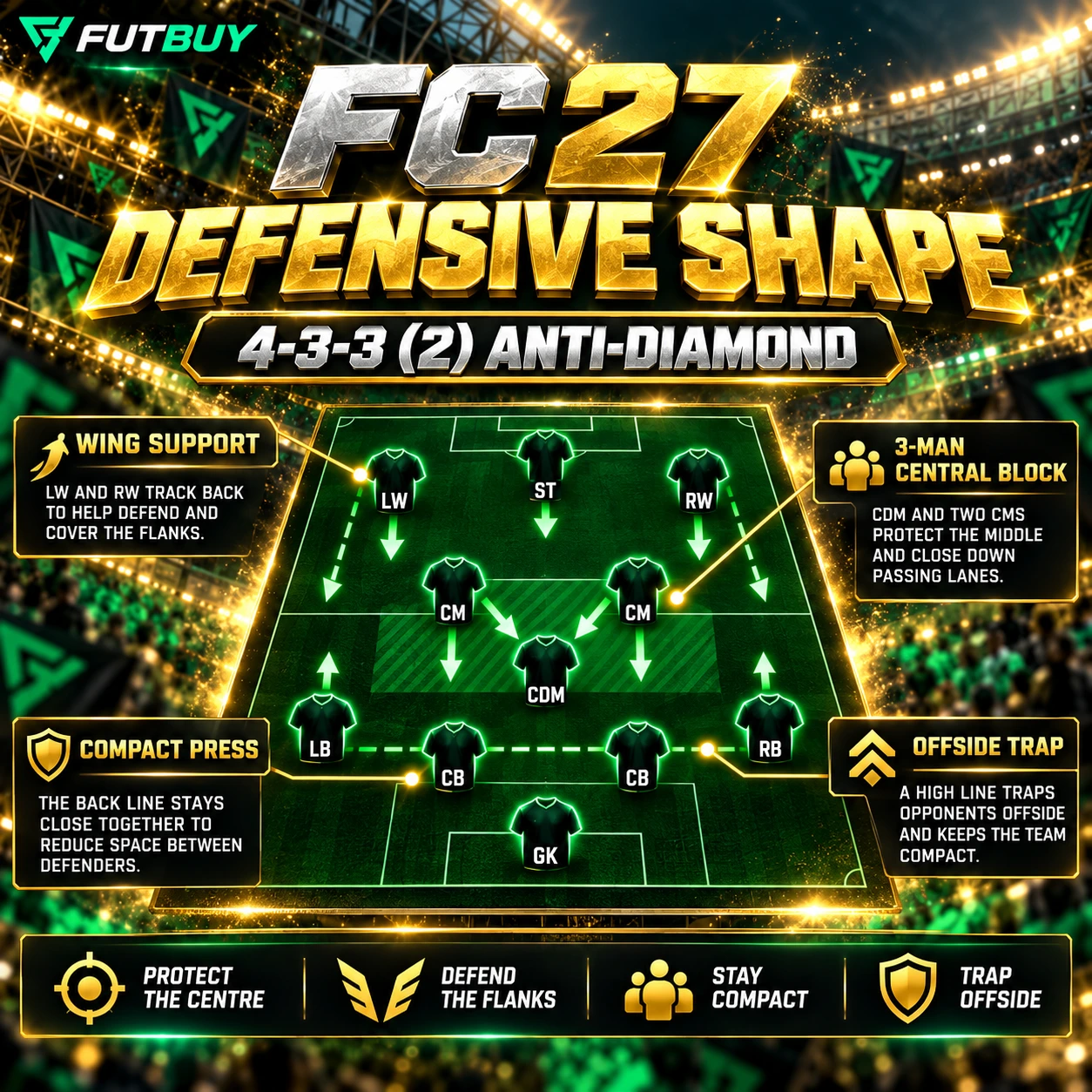
The attacking benefits are obvious, but the formation also offers an interesting defensive structure.
Three Midfielders Help Protect the Centre
Against narrow formations, one of the biggest problems is defending central passing combinations.
The opponent may have multiple players positioned close together, making it difficult to cover every passing lane.
The 4-3-3 (2) provides a natural three-player central midfield structure.
Your two CMs can help pressure the opposition's midfielders, while the CDM protects the area directly in front of your defenders.
This is particularly useful against teams that repeatedly attempt to move the ball through their CAM and strikers.
However, positioning still matters.
If you drag your CDM too far away from the centre, the defensive advantage can disappear.
Try to protect the most dangerous passing lanes instead of chasing every opponent.
Your Wingers Make Switching Play Less Comfortable
Another important advantage is how the formation responds to wide attacking movements.
Narrow formations sometimes try to escape central pressure by moving the ball toward a full-back.
But in the 4-3-3 (2), your wingers are already positioned to help contest those areas.
Even if the opponent manages to get past your winger, the nearest central midfielder can provide additional cover.
This gives you another layer of defensive protection.
Of course, the system will not automatically stop every attack.
Fast switches of play and well-timed overlaps can still cause problems.
But the overall structure makes it easier to contest both the centre and the wings without abandoning your midfield.
Do Not Forget the Offside Trap
One important detail from our testing is the use of the offside trap.
With a High Defensive Approach, there is always a risk of leaving space behind your midfield and defensive line.
This becomes especially dangerous when an opponent plays quick through balls.
A well-timed offside trap can help your defensive line step forward and reduce the space available to attacking players.
However, timing is essential.
Simply using the trap repeatedly is not a reliable defensive strategy.
If your opponent anticipates the movement, they may exploit the space behind your defenders.
Use the offside trap situationally, not automatically.
Combine it with careful player switching, manual positioning and awareness of forward runs.
For more defensive advice, check our FC 27 gameplay guide covering manual defending and defensive decision-making.
4-3-3 (2) vs 4-2-1-3 – What Is the Difference?
At first glance, these formations may look similar.
Both can use two wide attackers and one central striker.
Both provide opportunities for counterattacks.
However, the midfield structure changes the way they play.

Why Does 4-3-3 (2) Feel More Controlled?
The main difference is the positioning of the midfielders.
In 4-2-1-3, the CAM naturally operates closer to the striker.
That can make attacking transitions feel quicker.
In 4-3-3 (2), the two CMs start deeper and provide more support during possession.
As a result, your attacks may develop slightly more slowly.
However, you can gain a more connected midfield structure and additional stability when possession changes.
In our experience, 4-3-3 (2) sacrifices some immediate attacking speed for a more balanced overall shape.
This can be a worthwhile trade-off if you prefer to control matches rather than attack at maximum speed.
Best Player Profiles for FC 27 4-3-3 (2)
You do not need the most expensive Ultimate Team squad to try this formation.
However, certain player characteristics make the setup much easier to use.

Wingers Are Extremely Important
Your LW and RW need to be able to carry the ball forward and threaten defenders.
Quick acceleration is especially valuable during counterattacks.
Good dribbling also helps because you will sometimes need to hold possession while waiting for midfield support.
Choose a Striker Who Can Link Play
Because the provided setup uses a False 9, passing ability and movement become particularly important.
The striker should be comfortable receiving the ball with defenders nearby.
A player who can combine with the CMs and release wingers into space will make the system feel much smoother.
Do Not Ignore Your Central Midfielders
Your two CMs are crucial to the formation.
They need enough stamina to contribute at both ends of the pitch.
Good passing and ball control will help you maintain possession.
Defensive attributes are also useful because they regularly provide cover when the opponent attempts to attack through midfield.
Who Should Use the 4-3-3 (2) Anti-Diamond?
We particularly recommend this formation to players who:
Are tired of playing 4-3-1-2 or 4-1-2-1-2 (2).
Want more attacking width.
Prefer having three central midfielders.
Enjoy combining counterattacks with controlled possession.
Are comfortable triggering manual forward runs.
Want a more structured alternative to 4-2-1-3.
If those points describe your playstyle, this setup is worth testing.
Who Should Skip This Formation?
The 4-3-3 (2) may feel less comfortable if you:
Prefer two central strikers.
Want to attack immediately after every recovery.
Rely heavily on short passes around a central CAM.
Do not enjoy using wingers.
Struggle to recognise when to slow down an attack.
The biggest adjustment is learning when to accelerate and when to retain possession.
If you constantly force forward passes, you may struggle to get the best out of this formation.
Is FC 27 4-3-3 (2) Worth Trying?
Yes. We definitely recommend giving it a chance.
The formation surprised us.
We initially expected it to feel too slow compared with the popular attacking setups.
But after testing it, the balance between width, midfield support and defensive coverage made a strong impression.
There is something particularly satisfying about having multiple attacking options.
You can attack quickly through your winger, wait for your midfielder to arrive or use your striker as a passing option.
The formation does not force you into one attacking pattern.
However, it is important to understand its limitations.
You still need to defend manually, manage your high line and avoid rushing attacks when the opponent has numerical superiority.
The 4-3-3 (2) is not an automatic counter to every narrow formation.
But it gives you a different structure that can be very effective when used correctly.
Final Verdict – A Refreshing Alternative to the Narrow Meta

The 4-3-3 (2) Anti-Diamond is a genuinely interesting alternative to the popular narrow formations in FC 27.
It provides attacking width without completely sacrificing central midfield control.
The LW and RW make counterattacks more dangerous, the two CMs support your attacking combinations and the CDM adds stability in front of the defence.
Compared with 4-2-1-3, the formation feels slightly less direct but potentially more balanced.
Its biggest strength is flexibility.
You can attack quickly when space appears, but you can also slow the game down and build more carefully.
Its biggest weakness is that it demands patience and good timing.
You need to recognise forward runs, manage possession and use the offside trap intelligently.
Our recommendation: If you are tired of narrow formations and still have not found a system that suits your playstyle, give 4-3-3 (2) a try.
It might be exactly the change you need.
Need FC 27 Coins to Build Your Anti-Diamond Squad?

EA FC 27 is here, and the new Ultimate Team cycle has officially started.
The first days of the Web App and early access are always important: players are completing starter SBCs, farming Objectives, testing cheap meta cards and trying to build their first competitive squad as fast as possible.
If you want to strengthen your team early, coins can make a big difference. They help you buy key starter players, complete important SBCs, invest in useful cards and react faster to the market.
If you want to upgrade your squad and get a stronger start in Ultimate Team, you can check the latest FC 27 Coins prices on FUTBUY and build your club faster from day one.
FC 27 4-3-3 (2) Anti-Diamond FAQ

Is 4-3-3 (2) good in FC 27?
Yes. It offers a useful combination of attacking width, central midfield support and defensive balance.
Why is 4-3-3 (2) called Anti-Diamond?
Because its wingers can exploit the wide spaces around narrow formations while three central midfielders contest the middle.
What is the FC 27 4-3-3 (2) tactics code?
The code shown in the provided setup is ABZgi2c#K?2B.
Is 4-3-3 (2) better than 4-3-1-2?
Not universally. The 4-3-3 (2) offers more natural width, while 4-3-1-2 provides more direct central attacking combinations.
Is 4-3-3 (2) better than 4-2-1-3?
It depends on your playstyle. The 4-2-1-3 can feel more direct, while 4-3-3 (2) offers a different midfield structure and more patient build-up.
What is the best attacking strategy for 4-3-3 (2)?
Use your wingers on counterattacks, trigger forward runs and allow your CMs to join when the attack needs additional support.
What is the biggest weakness of 4-3-3 (2)?
Attacks can feel slower, and an aggressive defensive line can become vulnerable to well-timed through balls.
Should I use the offside trap with 4-3-3 (2)?
Yes, when appropriate. Well-timed offside traps can help manage space, but repeatedly forcing them can expose your defence.
Who should try the Anti-Diamond formation?
Players who want to move away from narrow systems while keeping strong midfield support and more attacking options through the wings.